 Five Fuji Instax Mini images translucently overlapped in Photoshop.
January 26, 2011

January 24, 2011
Diana Mini Panorama
I've been having problems with my Diana Mini: the shutter has been sticking in the open position, overexposing a lot of images. Three rolls of film, to be exact. But after a bit of shaking, poking, and jostling, the shutter seems to be working again.
The last two rolls I shot with the Diana Mini turned out as I had hoped they would. This is one of my favorite images: a panoramic shot of a tree from below. I was using the half-frame setting, so each individual image is portrait format, not square. I started on the left and worked my way to the right, only winding the film a little bit between exposures to create overlap in the images.
I'm happy that my little plastic princess seems to be working again. Stay tuned for more Diana Mini pics!
The last two rolls I shot with the Diana Mini turned out as I had hoped they would. This is one of my favorite images: a panoramic shot of a tree from below. I was using the half-frame setting, so each individual image is portrait format, not square. I started on the left and worked my way to the right, only winding the film a little bit between exposures to create overlap in the images.

I'm happy that my little plastic princess seems to be working again. Stay tuned for more Diana Mini pics!
January 20, 2011
Project 365
 To kick off the new year right and make sure I always keep a camera handy (haha), I've decided to participate in Project 365, with the goal of taking at least one photo each day in 2011. Some of them may be dedicated DSLR photos, while others might be mobile phone snapshots or instant pictures. The important thing is that there's an image for each day... and I think I'll share a few of them here just for fun.
The above collage is today's image, consisting of three Fuji Instax Mini pictures arranged in Photoshop. I've had a one-track photograpy mind lately — I seemingly can't take enough photos of bare, wintry tree branches, especially when there's a whitish gray sky behind them. So many shapes, so much contrast... I love it.
January 01, 2011
Through the Viewfinder
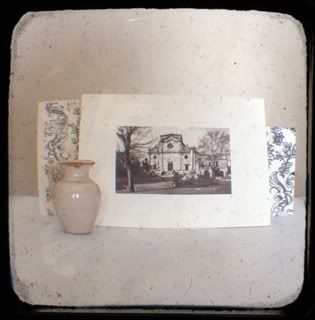
A little while ago, I became fascinated with TtV photography. TtV stands for Through the Viewfinder, and it’s one way to bring obsolete cameras back to life and spice up über-modern digital photography with a bit of an analog look.
TtV involves using two cameras to take a photo. One camera must be functional: a DSLR, a point-and-shoot digital camera, a modern film camera, or even a cell phone camera will work.
The other camera will be used strictly for its viewfinder. So the larger and more interesting the viewfinder, the better. The Argus Argoflex is perfect for this, as its viewfinder has approximately a 2” diameter. But as you’ll see a bit further down, many other cameras, including ones with small viewfinders, can also be used for different effects.
The process is quite simple. Step one: frame your shot using the older camera.
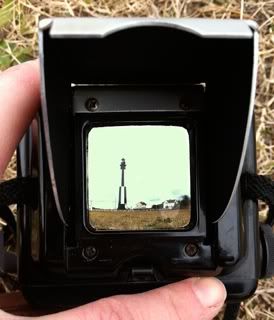 New Cape Henry Light is framed in the viewfinder.
Step two: use the other camera to take a photo of the viewfinder… just like I’ve done above. Step 3: Crop the photo to your liking. One benefit of TtV photography is that the edges of the viewfinder create an automatic frame for your image… like so:
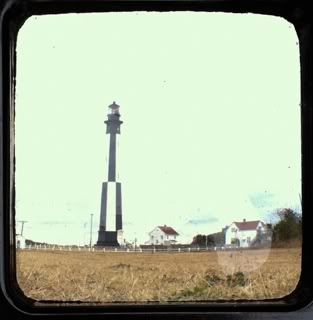 And that’s it!
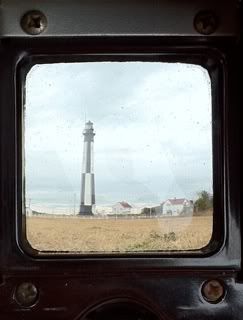 Ft. Story again. Here, the sky is less blown out, and I’ve left some more of the camera body in the image for a chunkier frame.
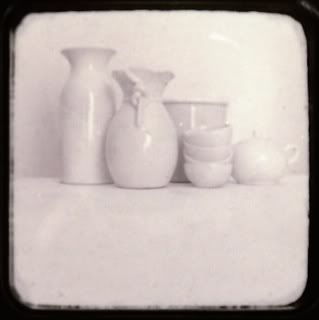
TtV is also great for still life photography at home:
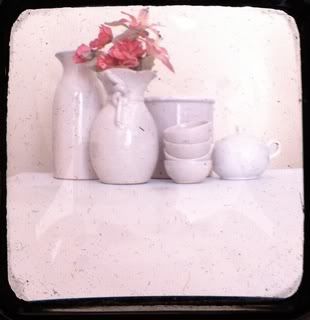 Here, I arranged some of my beloved ceramics from Vietri and some silk flowers. I was curious what this would look like with the camera set flat on the table. But if I were to do it again, I would probably prop it up at an angle, to shoot up higher.
TtV is one way to add some imperfections and analog charm to your photos, to give them a different character. Many old cameras will have plenty of dust in the viewfinder to add plenty of rustic charm to your images. But be careful not to focus on the dust specs, or your subject will be blurry while the dust specs take over:
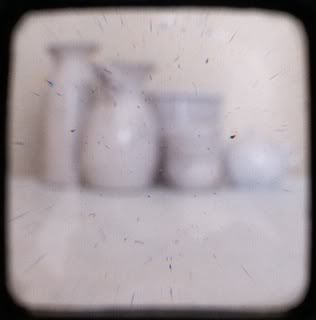 I didn’t realize it was THAT dirty inside!
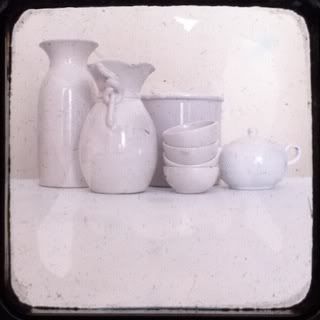 Ah, much better.
All of the above images were taken with the Argus Argoflex. But other cameras with much smaller viewfinders work as well. Here is a sample of images taken through teeny tiny viewfinders, all about the size of my pinky fingernail:
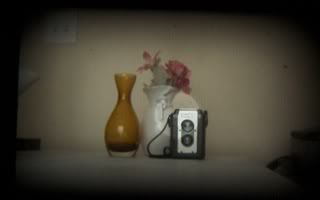 The Argoflex and a couple of vases through the viewfinder of an Argus 75, a 35mm camera from the 1970’s.
 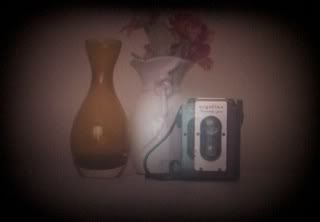 Canon AE-1. The light spot in the middle is the manual focus assist.
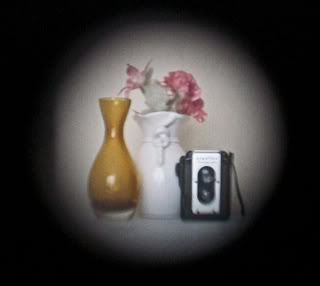 Even the Holga’s small round viewfinder will work!
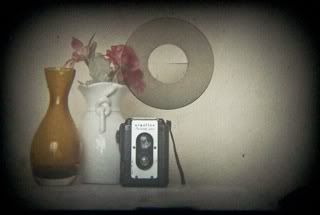 And… the Contaflex! Here, the focus assist and the surrounding ridges are clearly visible.
As you can see, the shape, color tint, and any other characteristics of the viewfinder all affect the final image. And yes, TtV can be done even with film. Check out these images, taken with a Canon AE-1.
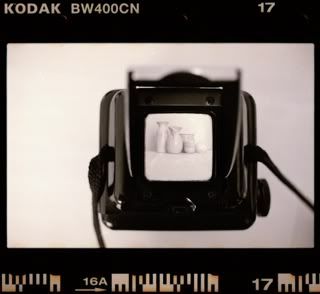 Looking down into the Argus Argoflex. I used black and white 35mm film, then scanned it as a color negative film to give it the slightest hint of cream-tone color.
 I have a few more TtV projects in progress, so look for more on this topic in the next few months.
December 22, 2010
Snow!
 Snow!
Snow!I knew that Virginia has distinct seasons, but I didn't dare to hope for real snowfall.
But voila! Last week we were blessed with a flaky, flurry gift from the sky that accumulated on the ground as a pleasingly crunchy layer of snow.
 New Cape Henry Light
When the flakes began to fall, I happened to be out running errands. I rearranged my plans and made my way to the lighthouse at Fort Story as quickly as I could, practically tripping over my own feet as I scrambled out of the car, camera in hand.
 After photographing the lighthouse, I started to walk back to the car — then changed my mind. I wasn't dressed to be outdoors for long, but I couldn't resist a quick detour. I had never seen the beach in the snow before, and this was my chance!
 Sandbags and sand dunes peek out from the accumulating snow.
 I made my way over the sand dune...
 ...and found the beach looking like this: covered in a white blanket that blurred the distinctions between sand, surf, and sky.
 Surf and snow resembled each other in the predominantly white landscape. I was mesmerized by the matching curvy contours of the border between sea and land.
 It was beautiful!
And just in case you're curious, the photos for this entry were taken with a Nikon D5000, using various in-camera monochrome settings, then processed with ShakeItPhoto for iPhone.
Fun, fun, fun.
December 18, 2010
Old Point Comfort Light
 Old Point Comfort Light
Old Point Comfort Light is located at the entrance to Hampton Roads, and at 207 years old, it is the oldest light in service in Chesapeake Bay. It is located on the grounds of Ft. Monroe, although its construction predates the fort by several decades. It is only 58 feet tall, yet its red light still serves to guide ships into the bay to this day.
December 03, 2010
Holga Love
 You might remember me mentioning that friends and family seemed to have conspired to spoil me with the perfect birthday gifts that all work together perfectly: a plastic Holga camera, a set of filters for it, and a negative scanner to digitize the resulting images. You may also remember that I immediately loaded it with 35mm film and tried it out in Rhode Island. But the camera is made primarily for medium format film, and -drumroll- I finally had the first two rolls of 120 film developed. Here are some of the images from the first roll. I used black and white film and a red filter... hence the dark, über-contrasty look.
 The Holga accompanied me on a trip to the Rosewell Ruins in Gloucester, VA.
 I was charmed by the ruins themselves...
 ...as well as the surrounding woods. I was so happy to see that my Holga's plastic lens really does add a bit of characteristic blur around the edges. Just like it's supposed to.
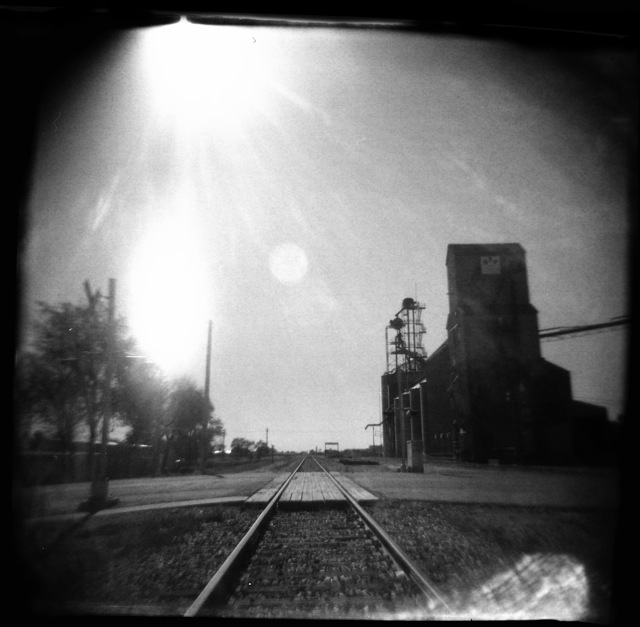 Grain elevators in Parkston.
 A photo of more railroad tracks in town, sporting the vignetting that is typical of Holga images.
 And a tree. Vignetting and blur... yess!
This was the trial run for the Holga loaded with the proper 120 film. OPTEST Sat!
Subscribe to:
Posts (Atom)